

Choosing detergent additives is not simply a matter of finding the cheapest raw material or adding more active ingredients.
A laundry detergent may contain surfactants, builders, enzymes, polymers, bleaching agents, optical brighteners, foam regulators and other functional ingredients. Each component has a different job, and the final washing performance depends on how these ingredients work together.
For detergent manufacturers, the more important question is therefore not "Which additive is the best?", but:
Which combination of additives is suitable for my detergent formula, washing conditions and target market?
This guide explains the main types of detergent additives, how they differ, when they are commonly combined, and where Sodium Carboxymethyl Cellulose (CMC) can add value as an anti-redeposition and soil-suspending polymer.

1. Why Detergent Additives Should Be Selected as a System
Modern laundry detergents are formulated as multi-component systems.
Surfactants mainly help wet the fabric, loosen oily and particulate soils, and keep removed soils dispersed in the washing liquor. Builders help manage water hardness and support cleaning performance. Enzymes target specific types of stains, while polymers can influence soil suspension, anti-redeposition and fabric-care performance.
This means that increasing the dosage of one ingredient does not necessarily produce a better detergent.
For example:
More surfactant does not automatically solve soil redeposition.
More builder does not replace an effective surfactant system.
More enzyme does not compensate for poor enzyme stability.
A higher-viscosity polymer is not automatically a better anti-redeposition agent.
A strong cleaning formula may still give poor results if removed soil settles back onto the fabric.
A practical detergent formulation should therefore consider several factors together:
soil type + fabric type + water hardness + washing temperature + detergent format + surfactant system + builder system + polymer selection + enzyme compatibility + target cost.
This is particularly important when developing concentrated liquid detergents, low-temperature detergents and products designed for repeated washing.
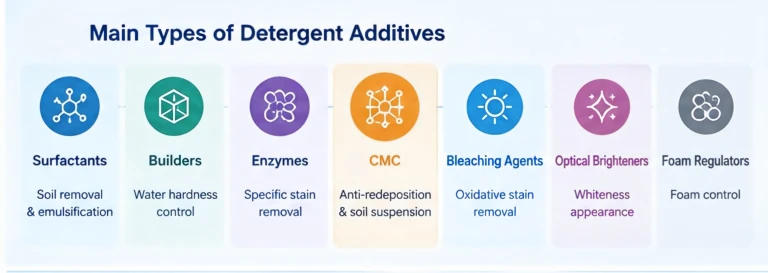
2. Main Types of Detergent Additives
Before selecting an individual raw material, it helps to understand what each ingredient category is supposed to do.
| Additive | Main Function | Typical Examples |
|---|---|---|
| Surfactants | Wetting, soil removal, emulsification | LAS, SLES, alcohol ethoxylates, APG |
| Builders | Water softening, alkalinity, cleaning support | Zeolite, carbonate, citrate, polycarboxylates |
| Enzymes | Targeted stain removal | Protease, amylase, lipase, cellulase |
| Anti-redeposition polymers | Keep removed soil suspended | CMC, polymeric soil-release agents |
| Bleaching system | Oxidative stain removal | Peroxide-based systems |
| Optical brighteners | Improve visual whiteness | Fluorescent whitening agents |
| Foam regulators | Control foam | Silicone-based defoamers and others |
| Fragrance & dyes | Product appearance and sensory characteristics | Fragrance, dyes |
| Chelating/sequestering agents | Control metal ions | EDTA and other chelators |
The exact composition varies considerably between powder detergents, liquid detergents, laundry pods, industrial detergents and specialty cleaning products.
3. Surfactants: The Main Cleaning Engine
Surfactants are generally considered one of the most important parts of a detergent formulation.
They reduce surface tension, improve wetting and help detach oily or particulate soils from textile surfaces. Different surfactants have different properties, so detergent manufacturers commonly use blends rather than relying on a single surfactant.
Anionic surfactants
Anionic surfactants such as linear alkylbenzene sulfonate (LAS) are widely used because of their strong detergency and relatively attractive cost-performance balance.
They are particularly useful for general soil removal.
Nonionic surfactants
Nonionic surfactants such as alcohol ethoxylates are often used together with anionic surfactants.
They can contribute to oily-soil removal and may improve performance under certain water hardness and temperature conditions.
Why use an anionic + nonionic surfactant system?
Instead of asking which one is "better," formulators often look at their complementary properties.
For example:
Anionic surfactant + nonionic surfactant
can provide a broader cleaning profile than either component alone.
Research on detergent formulations has also examined binary anionic/nonionic surfactant systems because surfactant selection and interaction can significantly influence the final cleaning performance.
However, surfactants alone do not solve every problem.
Once soil has been detached from the fabric, the next challenge is:
How do we keep that soil in the washing water until rinsing?
This is where detergent polymers such as CMC become important.
4. Builders: More Than Just Water Softeners
Builders are another major part of detergent formulation.
Hard water contains calcium and magnesium ions, which can interfere with cleaning performance. Builders help control these ions and can also contribute to alkalinity, soil dispersion and overall detergent performance.
Common builder systems include:
Sodium carbonate
Zeolites
Citrates
Polycarboxylates
Phosphate-based builders in markets where they are permitted
Other organic or inorganic builder systems
The correct choice depends on the detergent format, regulations, water conditions and cost target.
Builder + CMC: Different Jobs, Better Together
A useful point for formulators is that a builder and CMC should not normally be considered direct substitutes.
A builder mainly addresses water hardness and supports the washing process.
CMC, on the other hand, can function as a polymeric anti-redeposition and soil-suspending aid.
Therefore, a formulation may use:
surfactant + builder + CMC
rather than trying to make one ingredient perform all three functions.
This functional separation is often more practical when optimizing a detergent formula.
5. Enzymes: Excellent for Specific Stains, Not a Universal Solution
Enzymes have become important functional ingredients in modern detergent formulations.
Different enzymes target different types of stains:
Protease
Primarily used to break down protein-based stains such as blood, food residues and other protein soils.
Amylase
Targets starch-based stains.
Lipase
Helps break down certain oily and greasy soils.
Cellulase
Can be used for fabric-care purposes and to modify or remove small amounts of cellulose-based deposits from cotton fabrics.
Why enzyme selection needs care
Enzymes are highly functional, but they are also sensitive to formulation conditions.
Surfactants, builders, pH, preservatives, bleaching systems, water quality and storage conditions can all influence enzyme stability. Recent research continues to emphasize the compatibility challenge between enzymes and complex detergent matrices.
Therefore, simply increasing enzyme dosage is not always the best way to improve the final detergent.
A better approach is often:
appropriate enzyme + suitable surfactant system + controlled pH + compatible polymer system.
6. CMC in Detergent: What Does It Actually Do?
Sodium Carboxymethyl Cellulose, commonly known as CMC, is a water-soluble cellulose derivative that has been used in detergent formulations for many years.
One of its best-known functions is anti-redeposition.
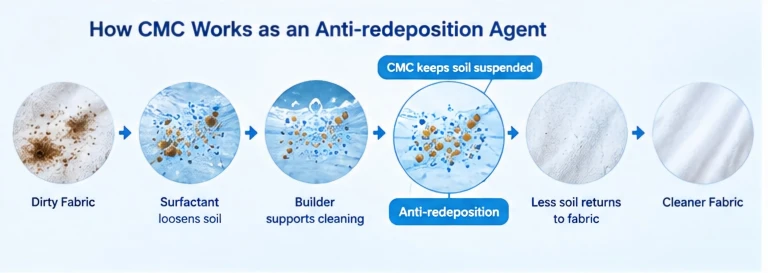
During washing, dirt is removed from clothing and becomes suspended in the washing liquor.
If the removed soil is not adequately stabilized, some of it can settle back onto the fabric.
The result may be:
Reduced whiteness
Grey appearance after repeated washing
Poor particulate-soil removal
Lower perceived cleaning performance
CMC can help keep suspended soil dispersed and reduce its tendency to redeposit on textile surfaces.
Technical literature identifies carboxymethyl cellulose as an established anti-redeposition agent in detergent formulations.
This is why detergent-grade CMC should not simply be viewed as a thickener.
For laundry detergent manufacturers, its functional role is often more closely related to:
soil suspension + anti-redeposition + formulation support.
7. CMC vs Other Detergent Polymers
CMC is not the only polymer used in laundry formulations.
Depending on the formulation, manufacturers may also consider:
Polyacrylates
Polycarboxylates
Polyethylene glycol (PEG)
Polyvinylpyrrolidone (PVP)
Soil-release polymers
Other cellulose-based polymers
Each has a different chemistry and performance profile.
For example, polycarboxylates can provide builder/cobuilder functions and influence the behavior of hardness ions, while certain polymers are designed specifically for soil release or anti-redeposition.
CMC has a different advantage: it is a cellulose-based, water-soluble polymer with a long history of use in detergent applications.
The right choice depends on the fabric, soil, detergent format and formulation system.
A simple comparison
| Material | Main Role | Best Consideration |
|---|---|---|
| CMC | Anti-redeposition / soil suspension | Especially useful for particulate soil and cotton fabrics |
| Polyacrylate / polycarboxylate | Builder/cobuilder, dispersion | Water hardness and formulation requirements |
| PVP | Dye transfer control / polymer function | Colored laundry formulations |
| PEG | Polymer/binder/functional additive | Specific formulation and physical-property needs |
| Soil-release polymer | Soil release from fabrics | Synthetic fabrics and repeated washing |
| Enzyme | Specific stain degradation | Protein, starch, oil and other targeted soils |
There is no universal "best polymer."
The better question is:
What problem are you trying to solve?
8. CMC vs Xanthan Gum: Why They Should Not Be Treated as the Same Product
This is a common question when purchasing detergent additives.
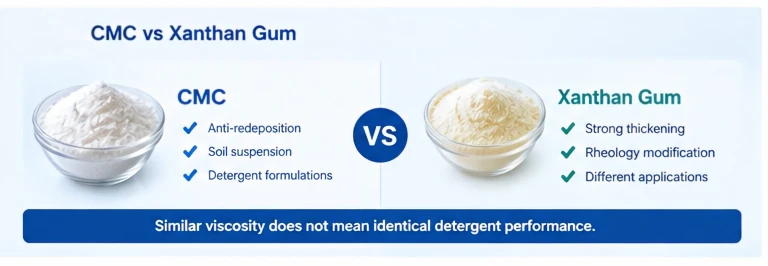
CMC and xanthan gum are both water-soluble polymers, but their formulation roles are not identical.
Xanthan gum is widely known for its strong thickening and rheology-modifying ability.
CMC can also contribute to viscosity, but detergent-grade CMC is often selected primarily for its anti-redeposition and soil-suspension function.
Therefore, replacing CMC with xanthan gum simply because both increase viscosity may not produce the same washing performance.
For a laundry detergent manufacturer, viscosity is only one parameter.
A more complete evaluation should include:
Soil suspension
Anti-redeposition
Dissolution
Compatibility with surfactants
Salt tolerance
Water hardness
pH stability
Final detergent viscosity
Storage stability
Cost per effective dosage
This is one reason why laboratory testing is more useful than comparing viscosity values alone.
9. Can CMC Be Used Together With Surfactants?
Yes.
In fact, CMC is normally considered as part of a broader detergent formulation rather than as a replacement for the surfactant system.
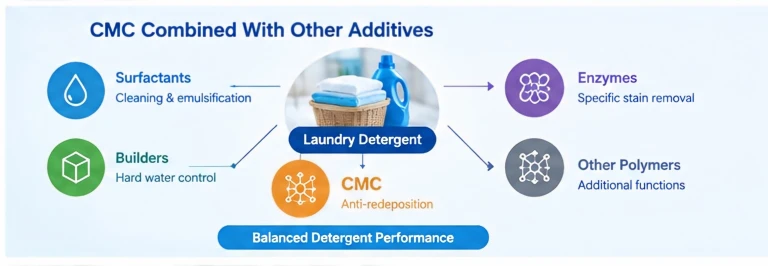
A simplified formulation concept may look like:
Surfactants → remove and emulsify soil
Builders → manage hardness and support cleaning
CMC → help suspend removed soil and reduce redeposition
Enzymes → attack specific stains
Bleaching system → oxidize suitable stains
Other polymers → provide additional fabric-care or formulation functions
This division of functions is more realistic than expecting one ingredient to solve every cleaning problem.
Published detergent formulation examples have included CMC at relatively low levels as an anti-redeposition ingredient, alongside surfactants, builders, enzymes and other functional components.
The actual dosage should always be established through formulation trials rather than copied directly from another detergent.
10. Powder Detergent vs Liquid Detergent: Does Additive Selection Change?
Yes.
The same raw material may behave differently depending on the physical form of the finished detergent.
Powder Detergent
For powder formulations, important considerations include:
Powder flowability
Solubility
Moisture
Compatibility with builders
Granulation process
Distribution of minor ingredients
Storage stability
CMC can be incorporated into powder detergent formulations as an anti-redeposition polymer.
Liquid Detergent
Liquid formulations introduce additional considerations:
Viscosity
Phase stability
Solubility
Electrolyte tolerance
Surfactant compatibility
Preservation
Long-term storage stability
A CMC grade that performs well in a powder formulation should not automatically be assumed to be the ideal choice for a liquid detergent.
This is why detergent manufacturers should evaluate the finished formula, not only the raw material specification.
11. How to Select the Right Detergent-Grade CMC
When purchasing CMC for detergent production, viscosity is important, but it should not be the only purchasing criterion.
We recommend evaluating at least the following factors.
1. Viscosity
Different CMC grades can provide different viscosity levels at a defined concentration and test condition.
The required viscosity depends on the application and formulation.
2. Degree of Substitution
The degree of substitution influences water solubility and other functional properties of CMC.
A suitable detergent-grade product should be selected according to the manufacturer's technical specification rather than simply choosing the highest DS available.
3. Purity
Consistent purity helps improve batch-to-batch formulation stability.
4. Dissolution
Good dispersion and dissolution are important, especially when CMC is added to liquid detergent systems.
5. Compatibility
The CMC should be tested with the actual:
Surfactants
Builders
Salts
Enzymes
Preservatives
Fragrance
Other polymers
used in the formulation.
6. Batch Consistency
For commercial detergent production, consistent viscosity and functional performance can be more important than obtaining the lowest initial raw-material price.
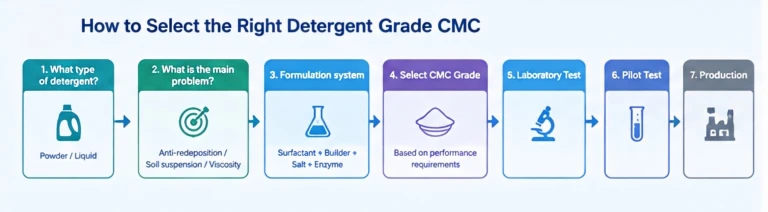
12. A Practical Way to Choose CMC Grade
Instead of asking:
"Which CMC has the highest viscosity?"
a formulator can work through the following questions:
What type of detergent am I producing?
↓
Powder / Liquid / Industrial / Specialty
↓
What is the main performance problem?
↓
Soil removal / Soil suspension / Anti-redeposition / Viscosity / Fabric care
↓
What is the surfactant system?
↓
Anionic / Nonionic / Mixed
↓
What is the builder and electrolyte level?
↓
Low / Medium / High
↓
What is the washing condition?
↓
Cold water / Warm water / Hot water
↓
What fabric and soil are targeted?
↓
Cotton / Polyester / Blends / Mixed soils
↓
Select CMC grade
↓
Laboratory test
↓
Pilot production
↓
Final production
This approach is usually more reliable than selecting CMC based on viscosity alone.
13. When Should CMC Be Combined With Other Polymers?
CMC does not necessarily have to work alone.
For some formulations, a combination of polymers can provide a broader performance profile.
For example:
CMC + Polycarboxylate
Potentially useful when the formulation requires both soil suspension/anti-redeposition and builder/dispersant functionality.
CMC + Soil-Release Polymer
This can be considered when the formulation needs both anti-redeposition and improved soil release, particularly for formulations targeting repeated washing and synthetic fabrics.
CMC + Enzymes
The two materials perform fundamentally different functions.
CMC helps with the physical behavior of detached soil, while enzymes chemically break down specific stain components.
Therefore, using both can make sense when the formulation requires both functions.
CMC + Anionic/Nonionic Surfactant Blend
This is perhaps the most straightforward formulation concept:
surfactants remove soil → CMC helps keep the removed soil suspended.
The actual compatibility and dosage must still be verified in the finished formulation.
14. Common Mistakes When Choosing Detergent Additives
Mistake 1: Choosing everything according to price
A cheaper additive is not necessarily cheaper in the finished formulation.
If a lower-cost material requires a higher dosage or produces inconsistent performance, the actual formulation cost may be higher.
Mistake 2: Comparing only viscosity
For CMC, viscosity is an important specification, but detergent performance cannot be judged from viscosity alone.
Mistake 3: Using too many functional ingredients
Adding more polymers, enzymes and surfactants does not automatically improve cleaning.
Too many components can increase formulation complexity and create compatibility or stability problems.
Mistake 4: Ignoring water hardness
The same detergent can behave differently in soft and hard water.
Builder selection and polymer performance should therefore be evaluated under realistic water conditions.
Mistake 5: Testing raw materials separately
A raw material may perform well in a simple laboratory test but behave differently after being combined with surfactants, salts, builders and enzymes.
The final detergent formula is what matters.
15. What Should Detergent Manufacturers Ask a CMC Supplier?
Before purchasing detergent-grade CMC, it is useful to ask the supplier for more than a price.
A professional inquiry should include:
CMC grade
Viscosity and test concentration
Degree of substitution
Purity
Moisture
pH
Particle size
Solubility/dispersibility information
Recommended application
Packaging
MOQ
Sample availability
COA
TDS
Batch consistency
Production capacity
Lead time
For larger-volume detergent production, it is also worth discussing whether the supplier can provide a stable grade over multiple shipments.
16. Detergent Grade CMC from Hondo Chemical
Zibo Hondo Chemical Co., Ltd. manufactures and supplies Sodium Carboxymethyl Cellulose (CMC) for different industrial applications, including detergent formulations.
For detergent manufacturers, Hondo focuses on CMC grades that can be evaluated for functions such as:
Anti-redeposition
Soil suspension
Rheology modification
Formulation support
Powder and liquid detergent applications
Different detergent formulations require different CMC characteristics. Instead of recommending one universal grade, we can discuss the detergent type, surfactant system, viscosity requirement and intended application before selecting a suitable grade.
Hondo has been producing CMC since 2008, with multiple production lines and an annual CMC production capacity of approximately 20,000 MT.
For detergent manufacturers, distributors and chemical importers looking for a China CMC supplier, technical specifications and samples can be discussed before a commercial order.
Product: Detergent Grade CMC
Chemical Name: Sodium Carboxymethyl Cellulose
Application: Laundry detergent, liquid detergent, powder detergent and related cleaning formulations
Manufacturer: Zibo Hondo Chemical Co., Ltd.
17. Final Thoughts: Choose the Function, Not Just the Chemical
There is no single detergent additive that can replace the entire formulation system.
Surfactants are responsible for much of the primary cleaning action. Builders help control water hardness and support detergency. Enzymes target specific stains. Bleaching systems address suitable oxidizable stains. Polymers can help manage soil suspension, anti-redeposition and fabric-care properties.
CMC has a specific and valuable position in this system.
Its role is not simply to make detergent thicker.
For many laundry formulations, the more important question is whether CMC can help keep removed soil suspended and reduce its return to the fabric during washing.
That is why the right CMC should be selected according to the complete formulation rather than according to viscosity or price alone.
For detergent manufacturers, the most efficient development process is usually:
Define the washing problem → select the functional ingredients → combine compatible materials → test the complete formulation → optimize dosage → scale up.
If you are developing a new detergent formulation or looking for an alternative CMC supplier, providing your current CMC viscosity, detergent type, dosage and basic formulation information can help make the grade-selection process much more precise.
Zibo Hondo Chemical Co., Ltd.
Detergent Grade CMC | Food Grade CMC | Oil Drilling CMC & PAC
Website: www.hondocmc.com


