

When CMC is added to water, the expected result seems simple: the powder should disperse, hydrate and eventually form a uniform solution. In actual production, however, this process can be much more complicated.
Lumps may appear on the surface of the liquid. Some powder may remain undissolved after long mixing. In other cases, the solution looks uniform at first but develops a different viscosity after standing.
These are common Instant CMC Dissolution Problems, especially when the CMC grade, powder addition method and mixing conditions are not properly matched.
For manufacturers using CMC in food, detergent, paper, textile, coating and other water-based formulations, understanding the dissolution process is just as important as selecting the right product.
What Is China Instant CMC?
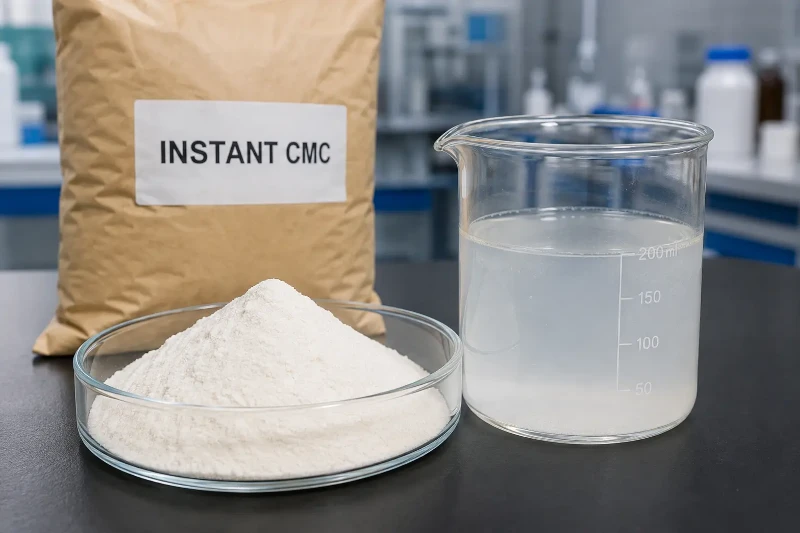
China Instant CMC generally refers to sodium carboxymethyl cellulose designed to disperse and hydrate efficiently in water under practical processing conditions.
CMC itself is a water-soluble cellulose derivative. Depending on its grade and formulation, it can function as a thickener, binder, water-retention agent, stabilizer, dispersant or rheology modifier. (Nouryon)
However, "instant" or "fast dissolving" should not simply be understood as "CMC that disappears immediately after touching water."
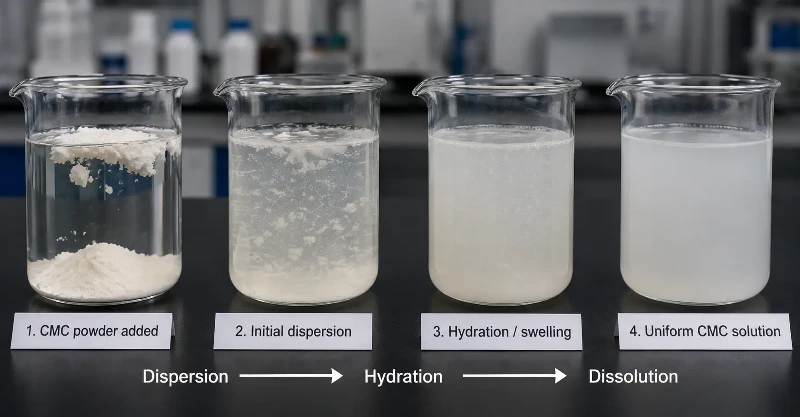
The actual process normally includes several stages:
Powder dispersion → Water penetration → Particle swelling → Hydration → Dissolution → Stable viscosity
This distinction is important. If CMC particles become heavily agglomerated before they are fully dispersed, water cannot easily penetrate the inside of the lump. The outside may hydrate first and form a viscous layer, making the remaining powder even more difficult to disperse. (Nouryon)
Therefore, a good Fast Dissolving CMC should be evaluated not only by how quickly it appears to dissolve, but also by its dispersion behavior, hydration characteristics and final solution uniformity.
Common Instant CMC Dissolution Problems
1. CMC Forms Lumps or "Fish Eyes"
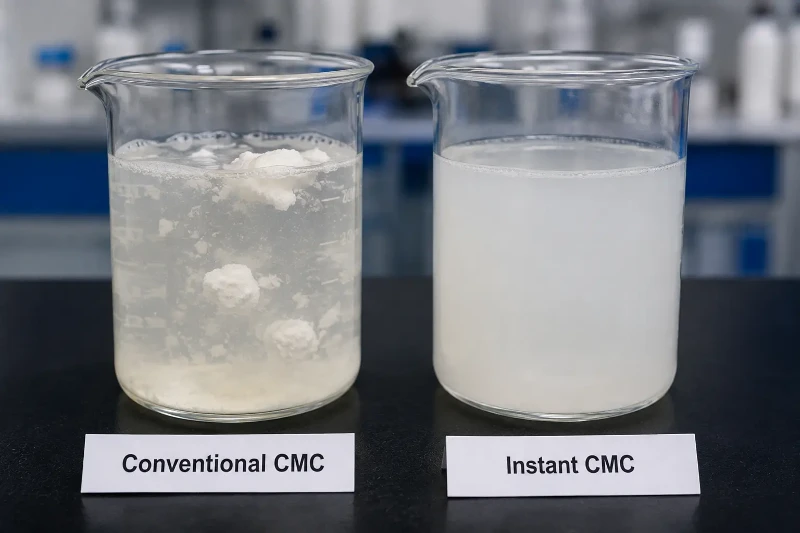
One of the most common problems is the formation of small or large CMC lumps immediately after adding the powder to water.
The outside of the particle absorbs water and becomes viscous while the inside remains dry. This creates a swollen surface around undissolved CMC.
Several factors can contribute to this problem:
Adding too much powder at one time
Poor water circulation
Insufficient agitation
Adding CMC directly onto the water surface
Using an unsuitable CMC grade
High CMC concentration
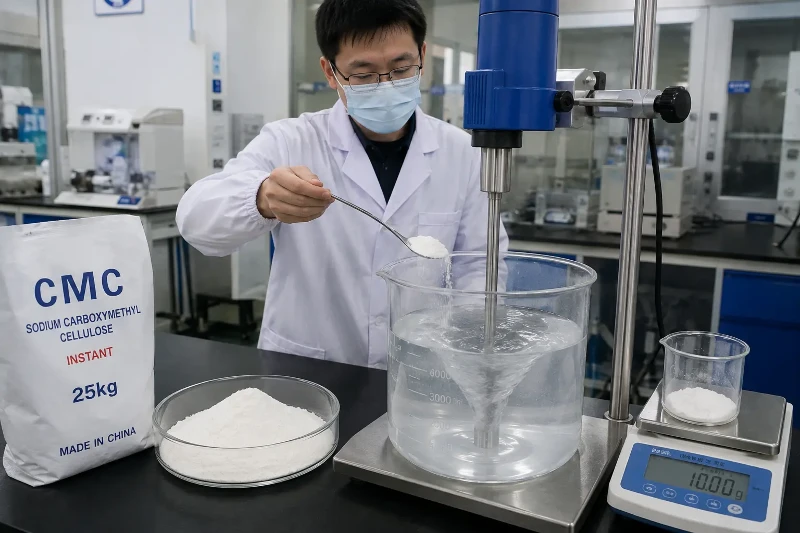
Technical guidance on CMC preparation also recommends dispersing the powder into an actively agitated liquid and controlling the addition process to minimize agglomeration. (Silverson)
2. Dissolution Takes Too Long
Another common complaint is that CMC remains cloudy or partially hydrated even after extended mixing.
Long dissolution time does not necessarily mean that the CMC is poor quality. The actual result depends on the interaction between the CMC grade and the customer's processing conditions.
For example, higher-viscosity CMC can require more effective dispersion because viscosity begins increasing as hydration proceeds. Once the liquid becomes highly viscous, powder movement and mixing can become more difficult. (Silverson)
This creates a practical challenge:
Poor initial dispersion → faster viscosity build-up around particles → more difficult mixing → longer dissolution time.
3. Final Viscosity Is Uneven
Sometimes the solution appears acceptable immediately after mixing but shows different viscosity after standing.
This can happen when some CMC particles have fully hydrated while others remain partially hydrated. The remaining particles may continue absorbing water during subsequent processing or storage, causing the viscosity to change.
For this reason, manufacturers should not evaluate CMC only by the appearance immediately after mixing. Hydration stability and final viscosity consistency are also important.
How to Improve CMC Dissolution
Control the Addition Rate
One of the simplest improvements is to avoid dumping a large quantity of CMC into water at once.
A controlled and even addition rate allows individual particles to become dispersed before significant hydration and viscosity build-up occur.
For industrial production, the feeding method should be considered together with the mixer design, liquid volume and target concentration.
Maintain Effective Agitation
CMC needs sufficient movement during the initial dispersion stage.
The objective is not simply to stir faster. The mixing system should create enough liquid circulation to distribute the powder throughout the water before the particles become highly hydrated.
For larger production systems, high-shear mixing can also help break down agglomerates and increase the contact area between powder and liquid. (Silverson)
Pre-Mix CMC With Other Dry Ingredients
For certain formulations, CMC can be pre-mixed with other dry ingredients before being added to water.
This can help physically separate CMC particles and improve powder distribution during addition. Technical guidance specifically identifies premixing CMC with ingredients such as sugar as one possible approach to improving dispersion. (Silverson)
Whether this method is suitable depends on the formulation and production process.
Choose the Right CMC Grade
Not every CMC grade is designed to provide the same dissolution behavior.
A buyer should consider more than the nominal viscosity listed on a specification sheet. Important factors can include:
Viscosity
Degree of substitution
Particle characteristics
Hydration behavior
Purity requirements
Application
Target concentration
Mixing conditions
A professional Instant CMC Manufacturer should therefore be able to discuss the application rather than simply recommend the highest-viscosity product.
When Should You Choose Fast Dissolving CMC?
Fast Dissolving CMC can be particularly useful when production efficiency and powder handling are important.
It may be worth considering when:
The production line has limited hydration time
Manual powder addition is used
CMC needs to be incorporated into a formulation quickly
Powder agglomeration is a recurring problem
The formulation requires consistent viscosity
Production capacity needs to be increased without unnecessarily extending mixing time
However, faster hydration is not automatically better for every formulation.
For some applications, controlled hydration may be preferable because it provides better control over viscosity development and processing behavior.
The right solution is therefore to match the CMC grade with the complete formulation and production process.
What Should You Ask an Instant CMC Manufacturer?
When evaluating an Instant CMC Supplier, buyers often focus mainly on price and viscosity.
A more useful technical evaluation should include several questions:
How does the CMC disperse in water?
What concentration and mixing conditions are recommended?
What viscosity range can be achieved at the customer's test concentration?
How consistent is the product from batch to batch?
Can the supplier provide samples for laboratory testing?
Can the grade be adjusted according to the application?
These questions can help distinguish a supplier that simply sells standard CMC from a manufacturer capable of supporting product selection and application development.
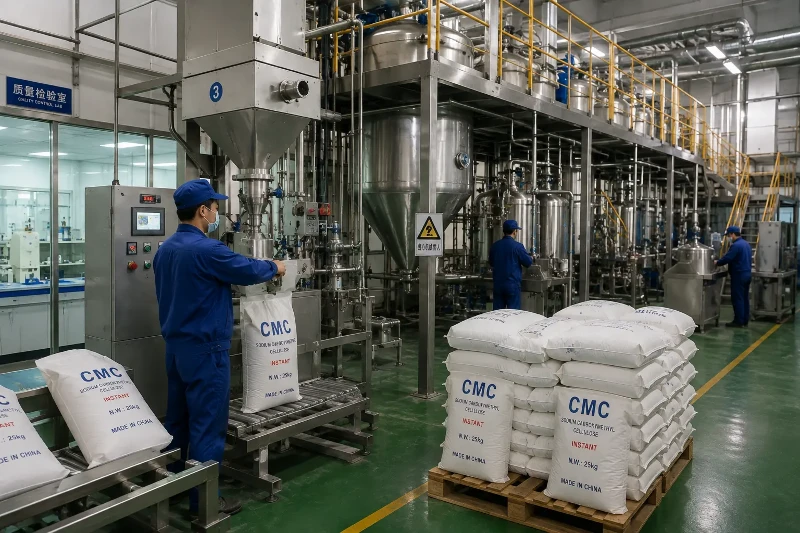
How a Professional China Instant CMC Supplier Should Control Quality
For an experienced China Instant CMC Supplier, product consistency should start before the CMC reaches the customer's production line.
Important quality-control factors include raw material selection, reaction conditions, purification, drying, milling and final powder characteristics.
The target is not simply to produce a CMC powder that meets a viscosity specification.
A well-designed product should provide repeatable dispersion, predictable hydration and stable final performance under the customer's normal processing conditions.
This is especially important for customers purchasing CMC for continuous industrial production. A small difference in hydration behavior can affect mixing time, viscosity control and the consistency of the finished product.
A professional supplier should therefore provide technical documents such as TDS and COA and, when necessary, support sample testing before commercial supply.
Instant CMC Selection Should Start With the Application
There is no single CMC grade that is ideal for every application.
A food manufacturer may prioritize purity, hydration and texture. A detergent producer may focus on viscosity and anti-redeposition performance. A paper or textile manufacturer may have different requirements for water retention, rheology and film-forming behavior.
This is why CMC selection should start with the customer's application, formulation and processing conditions.
Instead of asking only:
"What is the viscosity of your CMC?"
a better approach is:
"What are you using CMC for, what viscosity do you need, and how are you dissolving it?"
That information allows an Instant CMC Manufacturer to recommend a much more suitable grade.
Final Thoughts
Most Instant CMC Dissolution Problems are not caused by one single factor.
CMC grade, powder characteristics, addition rate, water conditions, agitation, concentration and processing time can all influence the final result.
The basic principle is straightforward:
Disperse first, hydrate properly, then allow the solution to reach stable viscosity.
For manufacturers looking for China Instant CMC, the most useful approach is to evaluate the complete performance of the product rather than focusing only on a single viscosity number.
A reliable Instant CMC Supplier should be able to provide consistent quality, technical documentation, samples and application-based recommendations.
Ultimately, the best Fast Dissolving CMC is not simply the powder that dissolves fastest in a laboratory beaker. It is the grade that provides efficient dispersion, predictable hydration and stable performance in the customer's real production process.


